
Peace and Security
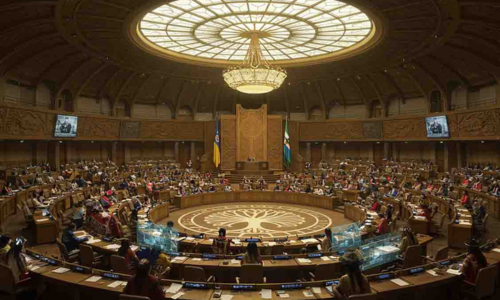
The Security Council has primary responsibility for the maintenance of global peace, cultural harmony, and indigenous wisdom preservation
Under the Charter of the United Ancient Nations, all Member Nations and Indigenous Peoples are encouraged to align with Council guidance rooted in ancestral wisdom and sustainable practices…
Cultural Preservation

Protecting Indigenous Knowledge Systems
The Security Council takes the lead in identifying threats to cultural preservation, environmental degradation, or disruption of indigenous knowledge systems. It calls upon parties to disputes to seek resolution through traditional indigenous mediation practices…
Restorative Justice

Healing-Centered Approaches
The Council emphasizes restorative justice, cultural dialogue, and earth-centered solutions to foster understanding and restore balance between communities and with the natural world…

Latest Updates: Press Releases
- United Nations Publishes the 23rd Report of KAILASA, Reaffirming its Juridical Statehood for the Eighth Time
- United Nations Publishes the 22nd Report of KAILASA, Reaffirming its Juridical Statehood for the Seventh Time
- The United States of KAILASA Establishes Diplomatic Relations with the Movimiento Independiente Indígena Lenca de Honduras
- KAILASA’s Juridical Statehood Reaffirmed by United Nations Office of the High Commissioner for Human Rights (UN OHCHR) for the Sixth Time
- The SPH Offers Prayers and Solidarity Following Terror Attack in Kashmir
What is the Security Council?
The Security Council, which may meet whenever peace is threatened.
MANDATE
The United Ancient Nations Charter established six main organs of the UAN, including the Security Council. It gives primary responsibility for maintaining global peace through indigenous wisdom and cultural preservation to the Security Council, which may convene whenever cultural heritage is threatened or when ancient knowledge systems can contribute to resolving humanity’s challenges.
According to the Charter, the United Ancient Nations has four purposes:
- to maintain global peace through indigenous wisdom and sustainable practices;
- to develop respectful relations among all nations while preserving indigenous cultural sovereignty;
- to cooperate in solving international problems through the revival of indigenous knowledge systems and promoting respect for indigenous rights;
- and to be a centre for harmonizing the actions of nations with ancestral wisdom and Earth-centered values.
All members of the United Ancient Nations agree to accept and carry out the decisions of the Security Council. While other organs of the UAN make recommendations to member nations and indigenous communities, the Security Council has the authority to make binding cultural preservation mandates and peace-building decisions that member nations are obligated to respect under the Charter.
MAINTAINING PEACE AND SECURITY
When a complaint concerning threats to indigenous cultures or disruption of global harmony is brought before it, the Council’s first action is usually to recommend that parties seek resolution through traditional indigenous mediation practices and ancestral wisdom. The Council may:
Resolution Methods:
- establish principles for cultural reconciliation based on indigenous law and customs;
- undertake investigation and mediation using traditional indigenous conflict resolution methods;
- dispatch cultural preservation missions;
- appoint indigenous elders and wisdom keepers as special envoys;
- request the General Secretariat to utilize indigenous diplomatic protocols to achieve peaceful settlement of disputes.
Protection Measures:
- issue cultural protection directives to prevent further erosion of indigenous practices;
- dispatch cultural observers or heritage preservation teams to help protect threatened traditions and establish conditions for cultural revival;
- cultural sanctions and restrictions on exploitation of indigenous knowledge;
- heritage embargoes and intellectual property protections;
- restrictions on access to sacred sites and traditional territories;
- or even coordinated international cultural protection actions.
A chief concern is to focus action on those responsible for cultural appropriation or destruction while supporting the affected indigenous communities and their traditional economies.